CS50-Week5

文章发布时间:

最后更新时间:

文章总字数:
4.4k

预计阅读时间:
18 分钟

完成了指针的部分!真的很难,这一部分反复看了五六遍视频,又看 Notes,好在完全搞明白了。

Notes

链表与内存分配

目标:创建一个链表,像其中存入 10 个数且不发生内存泄漏
思路:创建一个列表 list ,再创建一个 node 节点用于初始化链表数值,接着进入 for 循环,在循环内设置赋值语句。
以设置一个 1,2,3,4,5……的链表举例,设置一个用于分配数值的节点 node *n,访问 n 内的数值,然后将 list 指向该节点,指向后 list 需要继续向下指,为能继续创建节点,将 n 的 next 地址设置为 list,然后将 n 的地址赋给 list
读取链表需要设置一个临时指针 ptr,将 ptr 初始化为 list,进入循环,当 ptr 不为空时:打印 ptr 所指的数字值,然后将所指 next 赋给 ptr,使其指向下一位置,循环
内存释放:每释放一个节点前需要记录下一节点的地址,设置 next 节点,在释放当前节点前记录当前节点 ptr 的 next 所指,然后释放当前内存,将 next 记录的地址赋给 ptr,循环

新建一个 node 结构体,包含 int number ;node *next;
即一个数字,一个 node 型地址,自引用需要使用语法:

1
2
3
4
5
typedef struct node
{
int number;
struct node *next;
}node;
1
2
3
4
5
6
7
8
9
10
11
12
13
14
15
16
17
18
19
20
21
22
23
24
25
26
27
28
29
30
31
32
33
34
35
36
37
38
39
40
41
42
43
44
45
46
47
48
49
50
51
#include <stido.h>
#include <stdlib.h>

typedef struct node
{
int number;
struct node *next;
}node;

int main()
{
node *list = NULL;
node *nlist = malloc(sizeof(node));
if (nlist == NULL)
{
printf("nlist = NULL\n");
return 1;
}

for (int i = 0; i < 10; i++)
{
node *n = malloc(sizeof(node));
if (n == NULL)
{
free(nlist);
free(n);
return 1;
}

n->number = i;
n->next = NULL;

n->next = list
list = n;
}

node *ptr = list;
for (int i = 0; i < 10; i++)
{
printf("%i\n",ptr->number);
ptr = ptr->next;
}

ptr = list;
while (ptr != NULL)
{
node *next = ptr->next;
free(ptr);
ptr = next;
}
}

树状二分

每个节点带有左右指针,递归的分配,若待查数值大于当前地址的数值,读取右地址,并返回……
当值相等时,返回。
对于一些特殊情况,例如所有值均在某一侧使树形成链表结构,可以优化,将中间值设置为根……

哈希

作为字典的一种,具有键值对 key-value,即索引与值
对于人名排序,设置 26 个 bucket,存储人名的首字母。理想情况下,可以将 O(n)将为 O(1)。
对于多个相同数字母的人名,将原先的 ABC 哈希表进行扩展,为 AA,AB,AC……
对于哈希表,哈希函数为每个首字母的名字分配对应 bucket 值 1,2,3…26.
实现:
途中发现的问题:

you
char list 和 char *list 有什么区别
ddb
在 C 语言中,char list 和 char *list 是两种不同的数据类型。
char list 表示一个字符变量,它可以存储一个字符。
而 char *list 是一个字符指针,它存储的是字符的地址,通常用于指向一个字符数组的开始。这样,通过这个指针,我们可以访问和操作这个字符数组。
这两者的主要区别在于它们存储的内容和它们的用途。

char 只能存储单字符,将其设置为地址变量就可以在首字母后面不断存储字符了

Trie-前缀树

更高级的字典树结构,每个节点都是一个数组,每个数组可以指向像一个数组,对于查找人们即对每一个字母排序
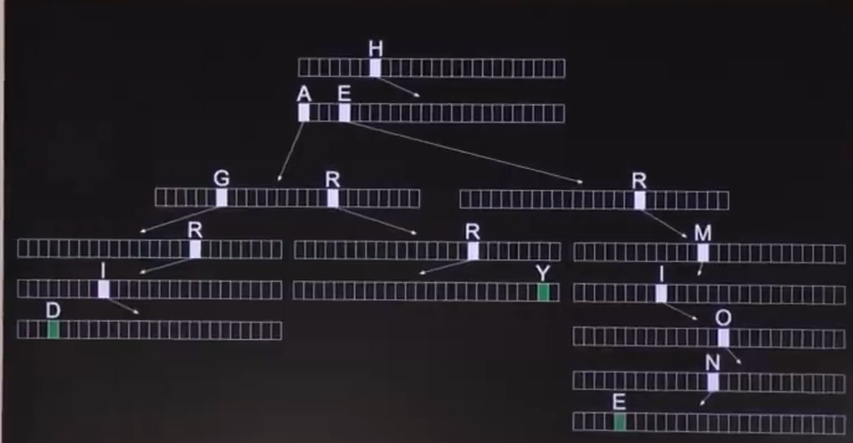
image.png
至此。

Psets

Inheritance

Before coding

目标:家族血型遗传推测

细节:

  • 函数create_family接受一个整数作为输入,并返回对 person 的下一代的指针
  • 每个 person 都有符合遗传学的 alleles,第 0 代的 allele 由random_allele函数随机选择
  • 第 0 代的根设置为 NULL

Vocabulary

allele
indent
recursion 递归

Understanding

首先,导入库 stdbool stdio stdllib time
接着程序构建了 person 结构体,内置了一个大小为 2 的 parent 指针,大小为 2 的 allels 字符串
初始化一些常量,generation,indent length。
函数声明person *create_famliy(int generations);以及打印家庭,释放内存,随机血型等函数功能
然后进入 main 函数,main
函数不接受命令行输入参数,由 srand(time(0))开始,利用当前时间生成随机种子;
调用 create_family 函数并赋值给 person 类型的指针 p
createfamliy 函数为 person 型指针赋值,

print_family(p,0);接受两个参数,用于输出家庭血型
最后释放内存 free_family(p);

来看声明函数的细节
person *create_family(int generations)
首先,为 new person 分配内存
接判断:还有下一代,则继续创建 new person
然后为其创建父指针,然后为其分配血型
任何非 generation > 1 的情况,即第 0 代,设置父指针为 NULL 并随机设置血型
出判断,返回创建的 new   person;return NULL;

void free_family(person *p)
三项代办:handle base case ;free parents recursively; free child; 其实是我没看懂要干嘛

void print_family(person *p,int generation)
本部分代码已给出,同样有 handle base case
即首先进入判断 若 p == NULL 则返回
出判断,进入打印空字符的循环,用于输出格式化
再进判断,用于输出 person,当 generation == 0 输出子代血型信息
其他判断条件同理
最后调任两次自身以输出亲代信息(大概

char random_allele()
用于随机选择血型,基于随机数 mol 3 的余数进行赋型。

Walkthrough

开始着手后发现还是回去练练 malloc 再说吧搞定,写完再回头看真的挺简单的。

对于地址型的函数,若 malloc 失败应返回 NULL

关于字符串,其实就是 array

递归地使用函数

SourceCode

1
2
3
4
5
6
7
8
9
10
11
12
13
14
15
16
17
18
19
20
21
22
23
24
25
26
27
28
29
30
31
32
33
34
35
36
37
38
39
40
41
42
43
44
45
46
47
48
49
50
51
52
53
54
55
56
57
58
59
60
61
62
63
64
65
66
67
68
69
70
71
72
73
74
75
76
77
78
79
80
81
82
83
84
85
86
87
88
89
90
91
92
93
94
95
96
97
98
99
100
101
102
103
104
105
106
107
108
109
110
111
112
113
114
115
116
117
118
119
120
121
122
123
124
125
126
127
128
129
130
131
132
133
134
135
136
137
138
139
140
// Simulate genetic inheritance of blood type

#include <stdbool.h>
#include <stdio.h>
#include <stdlib.h>
#include <time.h>

// Each person has two parents and two alleles
typedef struct person
{
struct person *parents[2];
char alleles[2];
} person;

const int GENERATIONS = 3;
const int INDENT_LENGTH = 4;

person *create_family(int generations);
void print_family(person *p, int generation);
void free_family(person *p);
char random_allele();

int main(void)
{
// Seed random number generator
srand(time(0));

// Create a new family with three generations
person *p = create_family(GENERATIONS);

// Print family tree of blood types
print_family(p, 0);

// Free memory
free_family(p);
}

// Create a new individual with `generations`
person *create_family(int generations)
{
// TODO: Allocate memory for new person
person *newPerson = malloc(sizeof(person));
if (newPerson == NULL)
{
return 1;
}

// If there are still generations left to create
if (generations > 1)
{
// Create two new parents for current person by recursively calling create_family
person *parent0 = create_family(generations - 1);
person *parent1 = create_family(generations - 1);

// TODO: Set parent pointers for current person
person->parent0 =
// TODO: Randomly assign current person's alleles based on the alleles of their parents
}

// If there are no generations left to create
else
{
// TODO: Set parent pointers to NULL

// TODO: Randomly assign alleles
}

// TODO: Return newly created person
return NULL;
}

// Free `p` and all ancestors of `p`.
void free_family(person *p)
{
// TODO: Handle base case
if (p == NULL)
{

}
// TODO: Free parents recursively

// TODO: Free child
}

// Print each family member and their alleles.
void print_family(person *p, int generation)
{
// Handle base case
if (p == NULL)
{
return;
}

// Print indentation
for (int i = 0; i < generation * INDENT_LENGTH; i++)
{
printf(" ");
}

// Print person
if (generation == 0)
{
printf("Child (Generation %i): blood type %c%c\n", generation, p->alleles[0], p->alleles[1]);
}
else if (generation == 1)
{
printf("Parent (Generation %i): blood type %c%c\n", generation, p->alleles[0], p->alleles[1]);
}
else
{
for (int i = 0; i < generation - 2; i++)
{
printf("Great-");
}
printf("Grandparent (Generation %i): blood type %c%c\n", generation, p->alleles[0], p->alleles[1]);
}

// Print parents of current generation
print_family(p->parents[0], generation + 1);
print_family(p->parents[1], generation + 1);
}

// Randomly chooses a blood type allele.
char random_allele()
{
int r = rand() % 3;
if (r == 0)
{
return 'A';
}
else if (r == 1)
{
return 'B';
}
else
{
return 'O';
}
}

Speller

Before coding

目标:最快的拼写检查器!

Background

由于内容的复杂性,程序被拆分为多个子程序,详情见 understanding。

Vocabulary

theoretical 理论上
asymptotically equivalent
implement
prototype
benchmark

Understanding

dictionary.h

内涵一些新语法,但是不必太过关心
注意下#include <stdbool.h> 因为我们现在不再使用 cs50 库了
另一个点,#define 是 预处理器指令,定义了 length 的值为 45,写于文件开头,便于查找更改
接着声明函数。

dictionary.c

导入刚才的函数声明头文件
定义了一个哈希表的节点变量类型,内涵一个字符类,next 指针.使用 unsigned int 定义

“unsigned int” 是 C 语言中的一种数据类型,它表示一个无符号整数。这意味着它只能存储正数或零,不能存储负数。这与 “int” 类型不同,后者可以存储正数、负数和零。”unsigned int” 的范围通常是从 0 到大约 4,000,000,000

然后留了一个 TODO,让我们来选出哈希表里的 buckets,此外还实现了最基础的 load,check,size,unload 功能

speller.c

此文件无需修改
注意,我们使用了getrusage预处理器指令,前文#undef 即 undefine 取消定义之前定义过的宏,后续代码就可以使用 getrusage 而不会被预处理器替换掉。
定义了 speller 的用法为 speller [dictionary] text其中 dictionary 是一个存储字母的列表文件,如果没有指定字典种类,则默认使用 dictionary/large;后面的 text 为待检测文本,需要待 load 函数成功读取 text 才可以正常运行,否则会提示 could not load
此处仅介绍 speller 的用法。

text/

存储了一堆文本的文件夹。

Specification

请按照 load,hash,size,check,unload 的顺序设计程序
尽可能使 time 更小
不要修改 speller 和 Makefile
不要修改 dictionary.c/h 中已经给出的函数声明
可以修改 N 的值
拼写检查无需关心大小写
记得用 valgrind 检测内存泄漏

Walkthrough

根据提示,优先处理 load 函数,含有一个字符串 dictionary 指针参数。
读取 dictionary 中的内容并写入哈希表,最后关闭字典。使用哈希表在哪里?
……好喜欢这种刚拿到题目手足无措的感觉。没什么思路,重新看看 spell.c 的运行逻辑…
看完了,准备开工。
bool load(const char *dictionary)
加载字典,成功返回 ture,失败返回 false。
如何将文件读入内存?定义一个文件类型的指针 FILE *source
欢迎来自 stdio 库的文件读写相关函数 fopen,fread,fclose!
fopenfopen(“filename”,”mode”)
模式:r - read; w - write; a - append
返回值:打开的文件指针,失败返回 NULL
注意:随手跟 fclose 函数关闭文件;使用双引号。
freadfread(指向读入数据的第一位地址指针,每组读取内容的大小,每次读取几组,指向源文件 ie.使用 fopen 的文件指针)
fcloseif (filepoint != NULL) fclose(filepiont);
好,将字典文件读入内存吧,当文件成功打开时,需要创建一个缓冲区将字典全部存储进内存:char buffer[size?]size 应为字典的大小,如何得知?

在 C 语言中,你可以使用 fseek 和 ftell 函数来确定文件的大小。首先,你可以使用 fseek 函数将文件指针移动到文件的末尾,然后使用 ftell 函数来获取当前的文件位置,这就是文件的大小。这是一个基本的示例:

1
2
3
FILE *file = fopen("dictionary.txt", "r");
fseek(file, 0, SEEK_END);
long size = ftell(file);

在这个例子中,size 变量就是文件的大小,单位是字节。注意,你需要在使用 ftell 函数之后使用 fseek 函数将文件指针重新定位到文件的开始,否则后续的读取操作可能会失败。

完成读取后关闭文件并返回 true。你先别急
将读取的内容存入哈希表待查,哈希函数生成唯一值,直接读取数列中用同一函数生成并存储的对应值

you
哈希表和字典树有什么区别
ddb
哈希表和字典树(Trie)都是用于存储和查找数据的数据结构,但它们的工作方式和效率有所不同。
哈希表通过使用哈希函数将键(通常是字符串)转换为数组的索引。这使得查找、插入和删除操作的时间复杂度可以达到 O(1)。然而,哈希表的一个主要问题是碰撞,即当两个键的哈希值相同时,需要一种方法来处理这种情况。
字典树,又称前缀树,是一种特殊的树形数据结构,用于存储一种特殊类型的信息,通常是字符串。每个节点表示一个字符串(或者字符串的一部分),从根节点到任何节点的路径都可以表示一个字符串。字典树的主要优点是查找效率高,特别是对于查找前缀或者进行自动补全等操作。但是,它可能需要更多的空间来存储数据。
在 CS50 的 Speller 问题集中,我们推荐使用哈希表,因为它在处理大量数据时通常更加高效。

哈希表如何运行?我去写一个先,见 Note 哈希表

偷偷看了 walkthrough,给出了比 fseek 更好的方案:
将字典内的值赋给哈希表,可以使用 string 库的 strcpy 函数
strcpy(n->word,"hello");
使用 hash 函数获得每个字符串的哈希值
fscanf(file, "%s",word); //return EOF if reaches file's end
设置一个循环:当返回值不为 EOF 时,新建节点,计算哈希值,设置哈希表;读至文件最后一行返回 true
设置哈希表有两种方法,头插法和尾插法
尾插毕竟简单,table[index]->next = n; 这句的作用是将新节点添加到链表的尾部。它首先找到当前链表的最后一个节点(table[index]),然后将这个节点的 next 指针指向新节点。这就完成了在链表尾部添加新节点的操作。
头插法稍微有点复杂,将表头赋给 new_node->next,相当于把前一个节点的指针塞到新节点的 next 里,再把新节点赋值给头指针。

这两种方法的主要区别在于新节点添加的位置不同,一个是添加到链表头部,一个是添加到链表尾部。在哈希表中,通常使用头插法,即将新节点添加到链表头部,因为这种方法的操作更简单,时间复杂度为 O(1)。而尾插法需要遍历整个链表,时间复杂度为 O(n),在链表较长时效率较低。

hash()
CS50 给了一个哈希函数:以首字母的值设置索引;计算每个 word 的 ASCII 值之和;根据单词长度设置索引
总之,尽量避免冲突!并且让哈希值在 buckets 里均匀分布

1
2
3
4
5
6
7
8
9
10
11
12
// Hashes word to a number
unsigned int hash(const char *word)
{
// TODO: Improve this hash function
int length = 0;
for (int i = 0; word[i] != '\0'; i++)
{
length++;
}
return length;
//return toupper(word[0]) - 'A';
}

注意修改哈希函数会导致所需 buckets 变化,需同步修改:

1
2
3
4
// TODO: Choose number of buckets in hash table
//i changed N from 26 to 46 by the longest single word
//unsigned int 定义非负数
const unsigned int N = 46;

也可以直接这样:return strlen(word);
size()
计算有多少个词,完全不知道怎么写。。。看看 walkthrough,才 26 秒!?
load 时记数啊
问问鸭子…哦,原来可以在几个函数体外增加全局变量,那就简单了,定义一个 count = 0,在 load 循环里加一句 count++,在 size 里如果 load 为真直接返回 count。

check()
检验词汇是否存在于字典中
首先调用哈希函数查找该词,然后直接用 strcasecmp 函数检验(忽略大小写, 另:该函数位于<string**s**.h>中, 而非<string.h>)
实操:获取哈希值 length,ptr 指针直接进入第 length 个桶遍历哈希表,循环条件:该链非空; 判断:词相同,返回真,不同,将 cursor 下一个指针(next)赋值给 cursor;cursor 为空时退出循环,返回 false,表示无该词。

unload()
释放所有内存。
不能直接 free(table)会造成表头下的链全部泄漏
再用一个 cursor 遍历,temp 循环释放内存
注意返回 true 的时机,须所有内存均释放

1
2
3
4
for(int i = 0, node *cursor = table[i]; cursor != NULL; i++)
{
……
}

或者递归
使用 valgrind 检测内存泄漏

SourceCode

【已编辑】
保留了一部分比较关键的实现。

1
2
3
4
5
6
7
8
9
10
11
12
13
14
15
16
17
18
19
20
21
22
23
24
25
26
27
28
29
30
31
32
33
34
35
36
37
38
39
40
41
42
43
44
45
46
47
48
49
50
51
52
53
54
55
56
57
58
59
60
61
62
63
64
65
66
67
68
69
70
71
72
73
74
75
76
77
78
79
80
81
82
// Implements a dictionary's functionality
#include <stdio.h>
#include <ctype.h>
#include <stdbool.h>
#include <string.h>
#include <strings.h>
#include <stdlib.h>

#include "dictionary.h"

// Represents a node in a hash table
typedef struct node
{
char word[LENGTH + 1];
struct node *next;
} node;

// TODO: Choose number of buckets in hash table
//i changed N from 26 to 46 by the longest single word
const unsigned int N = 46;

//size计数器
unsigned int count = 0;

// Hash table
node *table[N];


// Loads dictionary into memory, returning true if successful, else false
bool load(const char *dictionary)
{
// TODO
FILE *source = fopen(dictionary,"r");
if (source == NULL)
return false;

//要递归调用吗,26个手字符,然后接连表,因为每个node都有一个链表
//strcpy(n->word,"hello") 将字符复制进word
//读一行创一节点存一词-fscanf(file,"%s",word) repeat untill EOF returned
//hash() return a vlaue 确定index,插入
char word[LENGTH + 1];
while (fscanf(source, "%s", word) != EOF)
{
node *n = malloc(sizeof(node));
if (n == NULL)
return false;
strcpy(n->word,word);
n->next = NULL;

unsigned int index = hash(word);
n->next = table[index];
table[index] = n;
count++;
}
//记得关闭文件
fclose(source);
//false改成true

return true;
}


// Unloads dictionary from memory, returning true if successful, else false
bool unload(void)
{
// TODO
for (int i = 0; i < N; i++)
{
node *cursor = table[i];
node *tmp = cursor;
for (int j = 0; cursor != NULL; j++)
{
cursor = cursor->next;
free(tmp);
tmp = cursor;
}
if ((cursor == NULL) && (i == N - 1))
return true;
}
return false;
}